There is a particular kind of winter alchemy that happens in kitchens around the world when the temperature drops and the desire for something warm and sweet takes hold. It is the making of hot chocolate—a seemingly simple concoction that, when done right, feels like a velvet embrace for the soul. Yet, for all its comforting promise, a common kitchen tragedy often unfolds in the minutes after it's poured: the dreaded sludge at the bottom of the mug. This separation, where the rich cocoa powder abandons the liquid to form a dense, gritty paste, is the bane of hot chocolate enthusiasts and a puzzle that has vexed home cooks and professional chefs alike.
The quest for the ultimate, consistently smooth cup is not merely about taste; it's a textural pursuit. The ideal hot chocolate should be uniformly luxurious from the first sip to the last, with no unpleasant, sandy surprise waiting at the finish line. This is where the humble, often overlooked ingredient, cornstarch, enters the stage not as a thickener, but as a brilliant stabilizer. Its application, a simple pre-mixing technique, is the secret weapon that banishes sedimentation to the past, guaranteeing a perfectly homogenous beverage every single time.
The science behind the separation is a lesson in colloidal chemistry. Pure cocoa powder is hydrophobic—it repels water. When you whisk it into hot milk or water, you are essentially forcing these dry, water-fearing particles to suspend temporarily in the liquid. This is an unstable emulsion. As the drink sits, gravity takes over, and the heavier cocoa particles, no longer kept aloft by the energy of whisking, slowly sink and compact at the bottom. No amount of vigorous stirring can make these particles truly dissolve because they are not soluble; they can only be suspended.
This is the fundamental flaw that a mere whisk cannot overcome. Re-stirring might temporarily redistribute the settled cocoa, but it quickly settles again, often more compactly. It's a frustrating battle against basic physics. The solution, therefore, is not to mix better in the pot, but to transform the nature of the cocoa powder itself before it ever touches the hot liquid. We must change its relationship with water.
The ingenious workaround leverages a basic principle used in baking and sauce-making: creating a slurry. Cornstarch is a champion at absorbing water and forming smooth, stable pastes without lumps. By first mixing the dry cocoa powder with a small amount of cornstarch and just enough cold milk or water to form a thick, utterly smooth paste, you achieve a critical transformation. In this past state, the cornstarch granules surround the individual cocoa particles. As you gradually incorporate more liquid, the cornstarch helps to wet every single speck of cocoa, effectively eliminating its hydrophobicity.
The cornstarch acts as a bridge, a mediator that allows the cocoa to form a stable colloidal suspension with the water or milk. It coats the particles, making them less likely to clump together and fall out of solution. When this smooth base is then introduced to the remainder of your gently heating liquid, it integrates seamlessly. The result is a hot chocolate that possesses not only a flawless consistency but also a perceptibly silkier mouthfeel. The cornstarch, used in such a small quantity that it doesn't impart any flavor or create a gloopy thickness, works silently in the background solely as an emulsifying agent.
Mastering this technique requires a slight shift in procedure but pays dividends in perfection. Begin by assembling your ingredients: high-quality cocoa powder, sugar to taste, a tablespoon or two of cornstarch per serving, and your choice of milk, cream, or water. In a separate small bowl, combine the dry cocoa powder, sugar, and cornstarch. Whisk these dry ingredients together thoroughly to ensure they are completely evenly distributed. This initial dry mix is crucial for avoiding any pockets of pure cornstarch, which could become gelatinous later.
Next, slowly add a small amount of cold liquid—just a few tablespoons of milk or water—to the dry mixture. Using a spoon or a small whisk, vigorously work the liquid into the powders. The goal is to create a thick, dark, and perfectly smooth paste with absolutely no dry lumps whatsoever. This paste should be loose enough to pour but thick enough to coat the back of a spoon. This step is non-negotiable; patience here ensures a lump-free final product.
Now, in your saucepan, heat the majority of your milk or water until it is just steaming, not boiling. A gentle heat is key to preventing scorching and allowing for gradual incorporation. Reduce the heat to low and slowly add your cocoa-cornstarch paste to the warm liquid, whisking constantly. As you whisk, you will see it dissolve effortlessly into the liquid, creating a beautifully dark and uniform mixture from the very start.
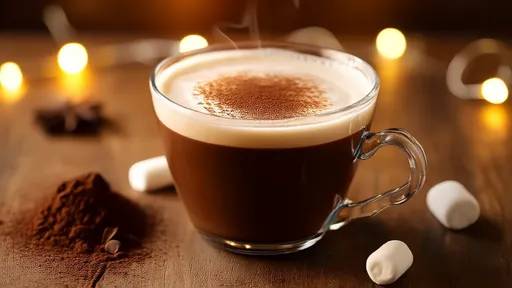
Continue to heat the mixture gently, stirring occasionally, until it reaches your desired serving temperature. You will notice it thicken slightly from the cornstarch, but the effect should be one of enriching the body and mouthfeel, not creating a pudding-like consistency. The transformation is complete. Pour it into your favorite mug and wait. You will observe that even after several minutes of sitting untouched, the liquid remains a uniform shade of brown, with no dark layer forming at the bottom. The first sip is smooth, the middle sip is smooth, and the final, triumphant sip is just as smooth as the first.
The implications of this simple trick extend far beyond the realm of hot chocolate. It is a fundamental technique that can be applied to any recipe where dry, hydrophobic powders need to be incorporated into a liquid. Think of spice rubs for stews, matcha powder for lattes, instant coffee for a smoother iced coffee, or even adding protein powder to shakes without those stubborn clumps. The cornstarch slurry method is a versatile tool that elevates kitchen craft, ensuring flawless texture and the full, intended flavor in every preparation.
In the end, this is more than just a recipe tip; it is a lesson in understanding the ingredients we work with. By respecting the scientific properties of cocoa powder and employing the right culinary technique to overcome its flaws, we unlock a new level of quality in our cooking and drinking. It proves that the barrier between a good homemade drink and a perfect, professional-level one is often not a rare ingredient, but a piece of knowledge. So the next time the wind howls and the craving for hot chocolate strikes, arm yourself with a box of cornstarch. You are not just making a drink; you are conducting a small experiment in culinary excellence, guaranteed to result in the smoothest, most satisfying cup you've ever had.
By /Aug 20, 2025
By /Aug 20, 2025
By /Aug 20, 2025
By /Aug 20, 2025
By /Aug 20, 2025
By /Aug 20, 2025
By /Aug 20, 2025
By /Aug 20, 2025
By /Aug 20, 2025
By /Aug 20, 2025
By /Aug 20, 2025
By /Aug 20, 2025
By /Aug 20, 2025
By /Aug 20, 2025

By /Aug 20, 2025
By /Aug 20, 2025
By /Aug 20, 2025

By /Aug 20, 2025

By /Aug 20, 2025
By /Aug 20, 2025
